

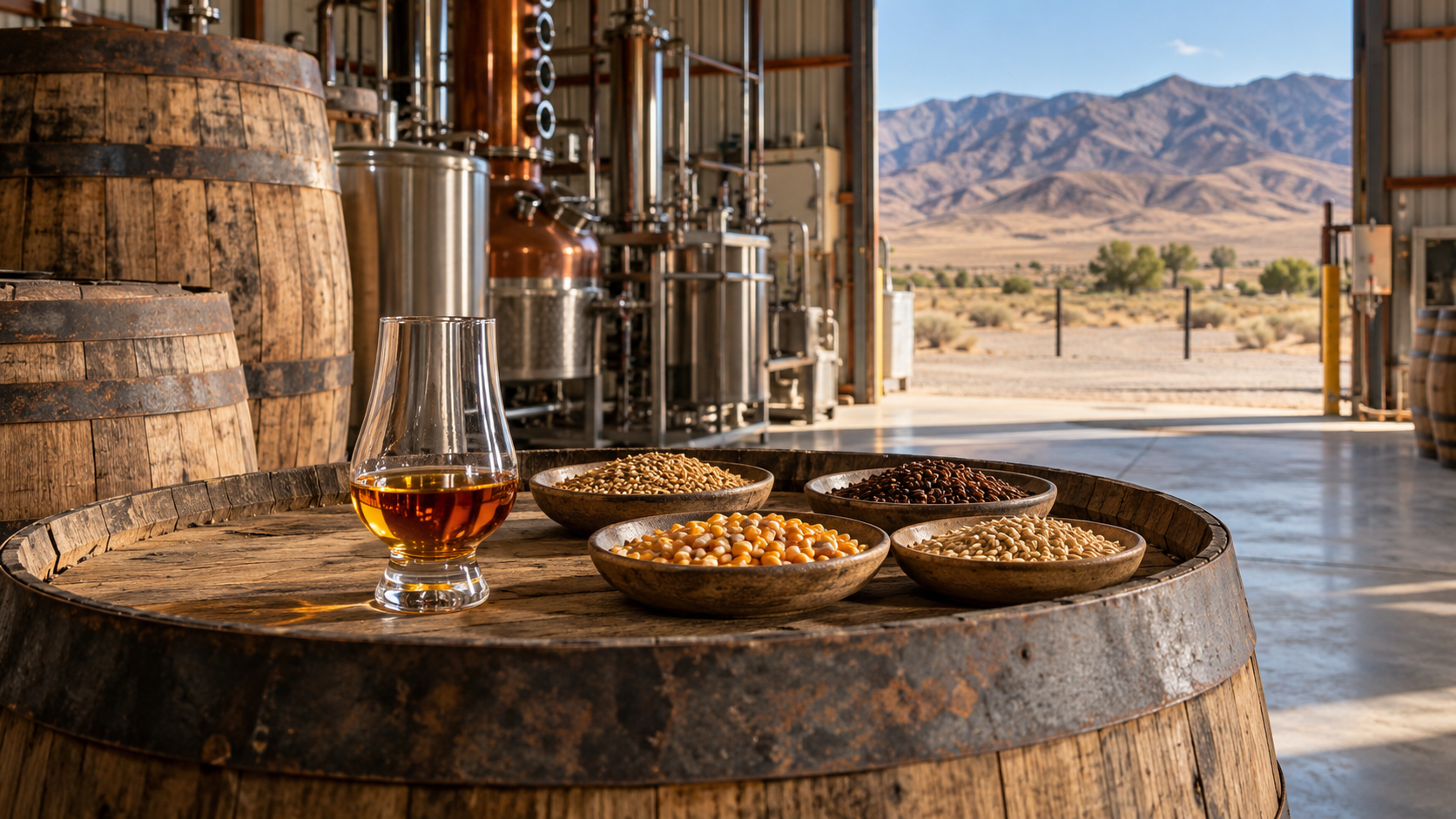

Frey Ranch: Bourbon, Backroads and the Western Journey
A whiskey farm in Fallon opens the door to a slower western adventure: Nevada bourbon, historic towns, rail journeys and the pleasure of learning something new.
THE PACIFIC44 JOURNAL · THE JOURNEY TO 60 AND BEYOND
By The Pacific44 Journal · Editorial Features
A whiskey farm in Fallon opens the door to a slower western adventure: Nevada bourbon, historic towns, rail journeys and the pleasure of learning something new.
There is a kind of trip that starts with a small curiosity. You notice a bottle from a place you had never associated with bourbon. You look up the town on the label. Soon, a Saturday distillery visit has become a reason to explore a part of the West you have mostly driven past.
Frey Ranch, in Fallon, Nevada, lends itself to that sort of journey. Its appeal reaches beyond what is poured in a tasting room. Here is a working farm whose owners decided the grain they raised deserved a finished product of its own. Follow that idea far enough and the trip becomes about agriculture, family enterprise, western history and the satisfaction of understanding how something is made.
For Pacific44 readers approaching retirement, or simply making more deliberate use of a weekend, this is an inviting way to travel. A good bottle can be the beginning of an interest. The reward is having a larger world to connect it to.
A bourbon road with a western accent
Kentucky has given bourbon tourism a powerful sense of place. Nevada offers another setting for the same curiosity: irrigated fields, mountain horizons and towns shaped by mining, railroads and the work of making a living in a demanding landscape. Bourbon itself is an American category, rather than a Kentucky-only designation. Federal standards include a grain mixture of at least 51 percent corn and storage in new charred oak containers, along with other production requirements.
The western bourbon road imagined here is a suggested journey, not an established branded trail. Frey Ranch is its whiskey anchor. Fallon, Virginia City and Genoa supply different chapters around it. Those towns are spread across northern Nevada; giving them several days allows each to be more than a stop made between pours.
That distinction matters to the pleasure of the trip. We would rather build a journey around one distillery worth understanding, a historic town worth walking and an afternoon with room to change plans. A trail can be a way of following your interests without turning them into an endurance event.
Before the still, a family and a farm
In their published account, Colby and Ashley Frey trace the family’s northern Nevada farming roots to 1854. They established the distillery in 2006 after wanting to see their crops become something more lasting than grain shipped away. That family history should not be confused with a claim that today’s distillery has operated since the nineteenth century.
Colby grew up working with his father on the farm. Ashley’s contribution includes the business’s identity, packaging and visitor experience. Both belong in the story. A successful destination depends on the work behind the product and on how people are welcomed into its world.
Frey Ranch describes a 1,500-acre operation where its whiskey grains are grown and the malting, milling, mashing, distilling, maturation and bottling happen on site. Colby and master distiller Russell Wedlake lead the farming and distilling process. The continuity gives an enthusiast unusually specific questions to ask: which grain went into this whiskey, how was it prepared, and what happened to it between harvest and barrel?
The cultural interest lies in that continuity. Farming knowledge has found a new expression without leaving the farm behind. Readers who have spent decades in a trade, profession or family business may recognize the attraction of doing something new with skills they already possess.
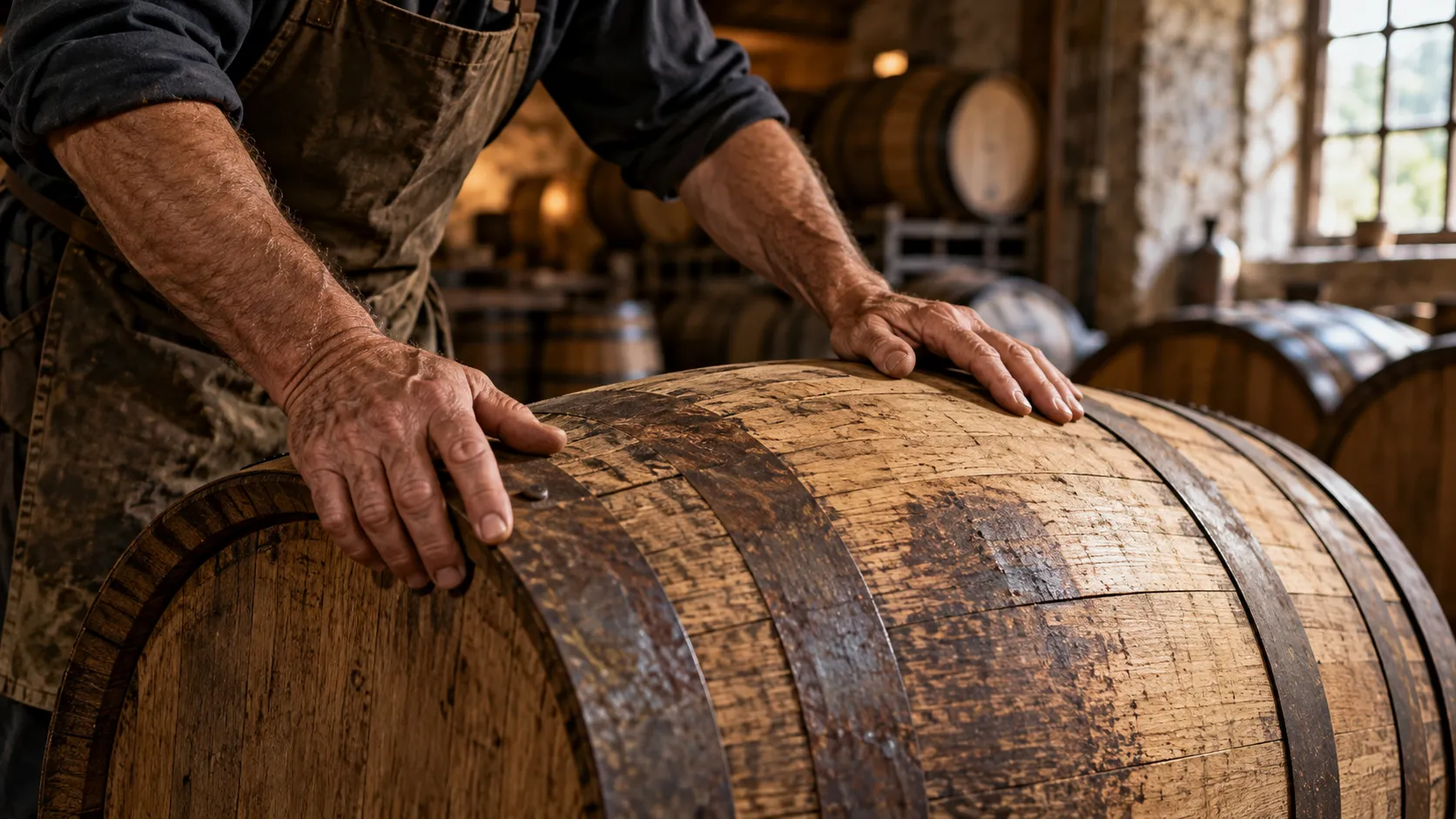
Read the whiskey through its ingredients
Start with the flagship four-grain Straight Bourbon. Frey Ranch currently describes it as five years old and bottled at 90 proof, or 45 percent alcohol by volume. Its grain recipe includes corn, winter cereal rye, winter wheat and two-row barley malted at the ranch. That recipe is the mash bill: a useful place to begin understanding the bottle, rather than a piece of jargon to memorize.
The producer’s notes mention oak and citrus aromas, followed by vanilla, caramel, banana chips and dried hay. Treat those descriptions as prompts supplied by the maker, rather than a tasting verdict from Pacific44. An enthusiast’s own impressions may be simpler, more particular or quite different. Recognizing an aroma from your own life is more valuable than reproducing someone else’s list.
Ask how the grains are prepared and what the barley contributes to production. Then ask about the barrel. The recipe begins the discussion, but fermentation, distilling choices, oak and time all give the visitor more to investigate. There is no need to force every difference in the glass into a single explanation about the soil or climate.
For a useful contrast, the ranch’s Bottled-in-Bond Straight Rye uses 100 percent winter cereal rye. Frey Ranch lists it at 100 proof and a minimum of five years old. Comparing a four-grain bourbon with a single-grain rye provides a focused question: how does changing the grain recipe change the experience? They are different whiskey styles, so approach them as a comparison rather than a contest.
The Farm Strength Uncut Bourbon creates another comparison. Frey Ranch presents it as the cask-strength version of its flagship, without the reduction to 90 proof; its published range is 120–132 proof. Read the individual bottle for the batch’s strength. A small pour and a little water can make an interesting experiment. Higher proof is a variable to explore, not a qualification for being a serious enthusiast.
A satisfying tasting can be modest: notice the aroma, take a small sip, consider the texture and pay attention to what remains afterward. Write down a few words you will understand later. Ask what adding water changes. The point is to become more observant, and to leave with a question you did not have when you arrived.
The field belongs in the conversation
The ranch’s account of its farming practices describes a seven-year crop rotation that includes alfalfa, gravity-fed flood irrigation and an exchange with the neighboring dairy: spent grain helps feed cows, while manure returns nutrients to the soil. These are the producer’s descriptions of its practices, rather than an independent environmental assessment.
They also give a visitor something concrete to examine. What remains after production? Where does it go? How does a farm balance the needs of the current crop with the health of the next one? Those questions connect the whiskey to an agricultural community and make the tour more interesting than an account of machinery alone.
At this stage of life, many of us are thinking about what we will pass on. A working farm brings that thought into practical view. Land, equipment and knowledge all need care. The bottle is a finished object, but the business that produces it must keep preparing for another season.
Give Fallon the afternoon
Frey Ranch is at 1045 Dodge Lane, outside Fallon. Its current visitor information lists complimentary Saturday tastings from noon to 4 p.m., with approximately 30-minute tours running twice an hour on average. The ranch asks groups of 11 or more to contact it beforehand. Check directly if your group has ten people, since the FAQ’s reservation wording leaves that number unclear.
The same page says the tasting room does not serve food, though visitors may bring food for the outdoor picnic tables. Plan lunch as part of the day. Special releases can sell out on release day, so an ordinary visit should be worthwhile without the promise of a particular bottle.
Make time for Fallon itself. The local visitor bureau points travelers toward the Churchill County Museum, whose collections help explain the community and the land around it. Beginning with local history gives the farm visit a setting beyond the distillery’s own story.
Nearby Grimes Point adds a much longer perspective, with Indigenous petroglyphs along an interpretive trail. The history of this region reaches far beyond settlement, saloons and silver strikes. View the rock art respectfully and leave it untouched. Hidden Cave is a separate guided opportunity; confirm arrangements rather than assuming it is included in a casual stop.
For travelers who would rather bring binoculars than add another indoor attraction, Stillwater National Wildlife Refuge offers a different reason to explore the Lahontan Valley. Choose the museum, the archaeological site or the refuge according to your interests and the conditions that day. Leaving something for a return visit is a perfectly good outcome.

Old towns, with more than a saloon story
Virginia City brings the mining West into the journey. Its nineteenth-century growth followed the Comstock discoveries of 1859. Today, the surviving schools, churches, opera house and mining history offer more to investigate than the familiar image of a frontier bar. Looking at how people worked, raised families and built institutions makes a historic town feel more substantial.
The Virginia & Truckee railroad, whose construction began in 1869, supplies a natural connection to Pacific44’s interest in rail travel. An excursion can give the landscape a different pace and viewpoint. Check the operator’s route, seasonal schedule and locomotive details before booking; the short Gold Hill outing and the longer Carson City–Virginia City experience are different arrangements.
Genoa offers another chapter in Carson Valley. Mormon Station interprets the trading post built in 1851 to supply travelers on the California Trail. The Genoa Bar dates its beginnings to 1853. Pairing a museum or historic park with a saloon allows the town’s history to be read through more than one doorway.
This is where the western bourbon-road idea becomes a culture journey. The distillery shows a contemporary enterprise building on inherited skills. The towns show earlier generations trying to create livelihoods, communities and places to gather. Neither story needs to be reduced to nostalgia. The interesting part is how much remains available to explore.
Build the trip around a Saturday
For readers arriving from Henderson or elsewhere in southern Nevada, treat this as a northern Nevada getaway with overnight stays. Frey Ranch places itself just over an hour from Reno, making Reno a possible base. Fallon suits travelers who want more time near the farm and local attractions; Carson City or Carson Valley may better suit the historic-town portion. Choose lodging around the shape of the trip, rather than assuming everything is clustered together.
One possible four-day outline is to arrive on Friday and leave room for a relaxed dinner. Reserve Saturday for Fallon and the ranch. Give Sunday to Virginia City, perhaps with a booked rail excursion. If the trip allows another day, explore Genoa before beginning the return. A shorter stay could simply combine Fallon with one historic town. These are editorial suggestions, not a packaged tour or a tested drive itinerary.
Arrange a designated driver or suitable hired transport before tasting, and confirm service beyond the cities. Keep road travel separate from drinking. Comfortable shoes, time between stops and a check of weather and road conditions will serve the trip better than another attraction squeezed into the schedule. Companions who do not drink should have a day they want to be part of, too.
An interest worth carrying into the next chapter
The Journey to 60 and Beyond leaves room for interests to deepen. Someone who has enjoyed bourbon for years might become curious about grain. A partner interested in history might find the towns more compelling than the tasting. A shared trip can accommodate both, with enough unassigned time for a good meal or an unexpected conversation.
There is a quiet pleasure in becoming a beginner again when so much of daily life depends on knowing what you are doing. You can ask a basic question on a distillery tour. You can stand in a museum and discover how little you knew about a town. You can take a train because you want to see where it goes.
A bottle brought home from Frey Ranch could carry the memory of all of that: a farm understood a little better, a western town explored at walking pace, a weekend given more attention. That is a worthwhile souvenir. It leaves you with something to enjoy now, and another reason to keep looking down the road.
Sources & planning
Frey Ranch founders · Farming and distilling · Straight Bourbon · Straight Rye · Farm Strength · Farm practices · Tastings and tours · TTB whiskey standards · Explore Fallon · Grimes Point · Stillwater visitor information · Virginia City history · V&T excursions · Mormon Station · Genoa Bar
Researched Pacific44 culture and travel feature; no firsthand visit, interview or tasting is implied. Tasting descriptions are attributed to the producer. The opening image is an AI-generated editorial illustration, not a photograph of Frey Ranch. Visitor and product details checked October 12, 2026; confirm current hours, releases and travel arrangements directly.
Image
Gallery.


Join the Journey!
Stories, places, music, ideas & inspiration for the journey to 60 and beyond — delivered from Pacific44.

Explore
Related posts.

Follow the
Journey.
@pacific44_lifestyle