

Third Eye Books: Books for the Long Way Home
A Black-owned Portland bookstore invites a deeper reading journey through cultural memory, family stories and the perspectives that can enlarge our next chapter.
THE PACIFIC44 JOURNAL · THE JOURNEY TO 60 AND BEYOND
By The Pacific44 Journal · Editorial Features
A Black-owned Portland bookstore invites a deeper reading journey through cultural memory, family stories and the perspectives that can enlarge our next chapter.
A bookstore visit can begin with a title we already want. The more interesting visits sometimes change that intention. An unfamiliar author, a conversation or a book placed beside another can show us a question we had not thought to ask.
Third Eye Books Accessories & Gifts in Portland offers a specific reason to make room for that encounter. Its founders describe a business centered on African-centered books, cultural pride and a relationship with the surrounding community. That point of view gives the browsing a direction.
For Pacific44, it belongs in a fuller picture of the West. A region's culture is made through independent businesses, the people who establish them and the ideas they choose to make available. A travel itinerary can become more interesting when it includes those places.
A shop with a stated purpose
Michelle Lewis and Charles Hannah founded Third Eye in 2019. Their published account identifies it as a Black-owned and operated business and describes an intention to support cultural knowledge and community organizations.
The current contact page lists the shop at 2518 Southeast 33rd Avenue. Confirm opening hours and any events directly before visiting. A small independent business may have arrangements that deserve more care than simply assuming it follows a large retailer's schedule.
Its identity should be part of the reason to go. Ask about books that express the shop's interests, or an author whose work you have not encountered. A visit becomes more substantial when the staff's knowledge and the business's purpose can inform the choice.
The store is not a symbolic stop to be checked off. It is a working business with customers, stock and people doing their jobs. Browse thoughtfully, ask when staff have time and support the shop if you find something you want to read.
Begin with an honest question
A useful question can be simple: which book would you suggest for someone interested in family history, music or a particular period? Giving a clear interest makes a recommendation more personal than asking for the universally best book.
A reader nearing retirement might be drawn to legacy, identity or the relationship between memory and place. Those themes can also lead beyond familiar experiences. A good reading life includes work that changes what we think we already know.
Avoid asking one book to stand for an entire culture. An author writes from a particular perspective, in a particular form. Ask what distinguishes the work, and whether another book would offer a contrasting view.
A bookstore can help build those connections, but the reading is still yours to do. Take time with the opening pages where permitted. Notice whether the voice holds your attention, and leave room for a choice that is less immediately comfortable.
A novel about what is preserved
Diane Wilson's The Seed Keeper offers one reading possibility connected to Pacific44's interests. Milkweed Editions describes a novel spanning generations of a Dakota family, with Rosalie Iron Wing's return to her childhood home opening questions about family, identity and what has been protected through hardship.
Seeds carry part of that story, linking material survival with knowledge and memory. The publisher also places the book's family history in relation to losses and the trauma of boarding schools. Those elements should be approached on their own terms, not reduced to a reassuring lesson about starting over.
For a reader thinking about what will be passed on, the premise can open a serious conversation. What do families preserve? What can be lost when a story is not told? A novel can make those questions felt through characters rather than an abstract argument.
This is a description based on the publisher's account, not a claim that Pacific44 has completed a new critical review. Confirm whether Third Eye has the book in stock or can order it; its inclusion here does not establish current inventory.

Another way to consider our relationship with place
Robin Wall Kimmerer's Braiding Sweetgrass brings Indigenous knowledge and botanical science into a conversation about the living world. The author is a botanist and a member of the Citizen Potawatomi Nation; her work invites attention to relationships and reciprocity.
It offers a different form from a multigenerational novel. A reader can move between narrative and reflection, considering how knowledge is acquired and what obligations may accompany it.
Placed alongside a book such as The Seed Keeper, it suggests a reading journey rather than a fixed list to complete. Similar interests can be approached through different authors, nations, forms and questions. That variety is part of the value.
Ask a bookseller for another work that extends or challenges the pairing. A good third choice may come from the conversation in the shop, rather than an algorithm predicting something very similar to the last purchase.
Give reading a place in the trip
A book bought while traveling can become a companion during the rest of the journey. Read a few pages at breakfast or during a rail segment. The place where it was found may remain part of its memory.
For a Portland visit, a bookstore can be paired with a café or another independent cultural stop without making the day overly full. Choose a manageable area and allow realistic travel time between addresses.
A couple may browse differently. One person might want history while the other prefers fiction or music. Let each choose something, then make time later to explain the choice. Shared reading does not have to mean reading exactly the same book.
Events can add another dimension, but they depend on the current calendar. Verify dates, registration and any requirements before making an author appearance central to the visit.

Bring the conversation home
The purchase is only the beginning. Give the book a place where it will actually be read. A modest reading routine is more useful than a stack that becomes another obligation.
If a passage raises a question, note it. Discuss it with a friend, a reading group or your partner. You can seek another source when a subject is unfamiliar, without expecting one writer to provide a complete account.
A next-chapter reading life can be deliberately varied: fiction, history, poetry, science and work rooted in experiences different from our own. Curiosity has room to become more demanding as well as more enjoyable.
For the Journey to 60 and Beyond, the value of a bookstore is the possibility of remaining open to that change. Third Eye's purpose provides a specific entry into the conversation; the reader's attention carries it onward.
Leave with a book that interests you. Give it the time that made the visit worthwhile, and let its questions lead somewhere new.
Sources & planning
Third Eye's founders and contact information · The Seed Keeper · Braiding Sweetgrass · Robin Wall Kimmerer
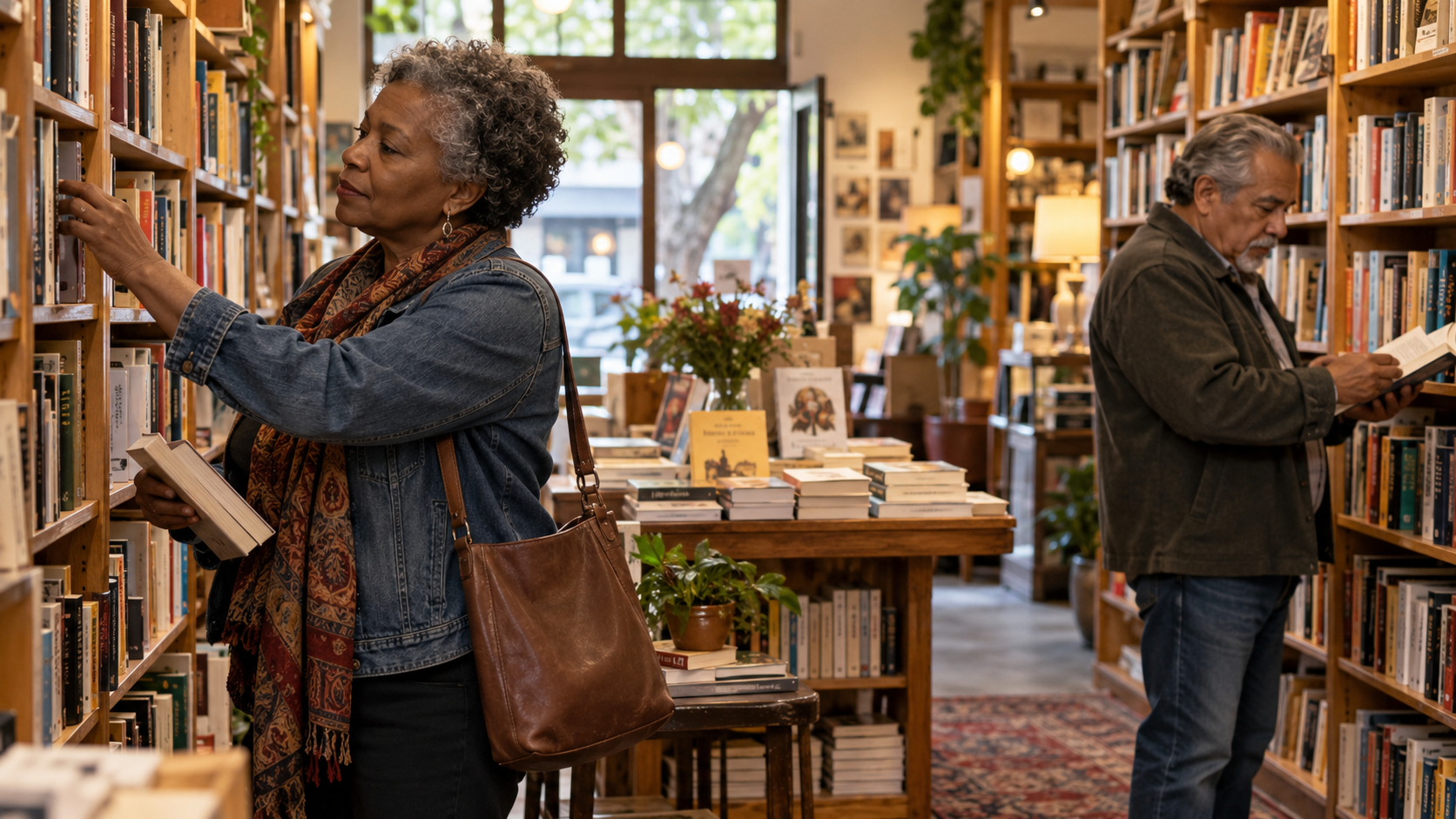
Researched Pacific44 magazine feature; no firsthand visit, interview or product review is implied. The opening image is an AI-generated editorial illustration, not a photograph of the named business or destination. Information checked October 12, 2026; confirm current arrangements directly.
Image
Gallery.


Join the Journey!
Stories, places, music, ideas & inspiration for the journey to 60 and beyond — delivered from Pacific44.

Explore
Related posts.

Follow the
Journey.
@pacific44_lifestyle