


The Road to Keeneland — Part Four: Where’s the Announcer?
Bourbon, tradition, United Tote and the invitation that turned a Kentucky work trip into a lifelong connection. Allen discovers why Keeneland had no race announcer.
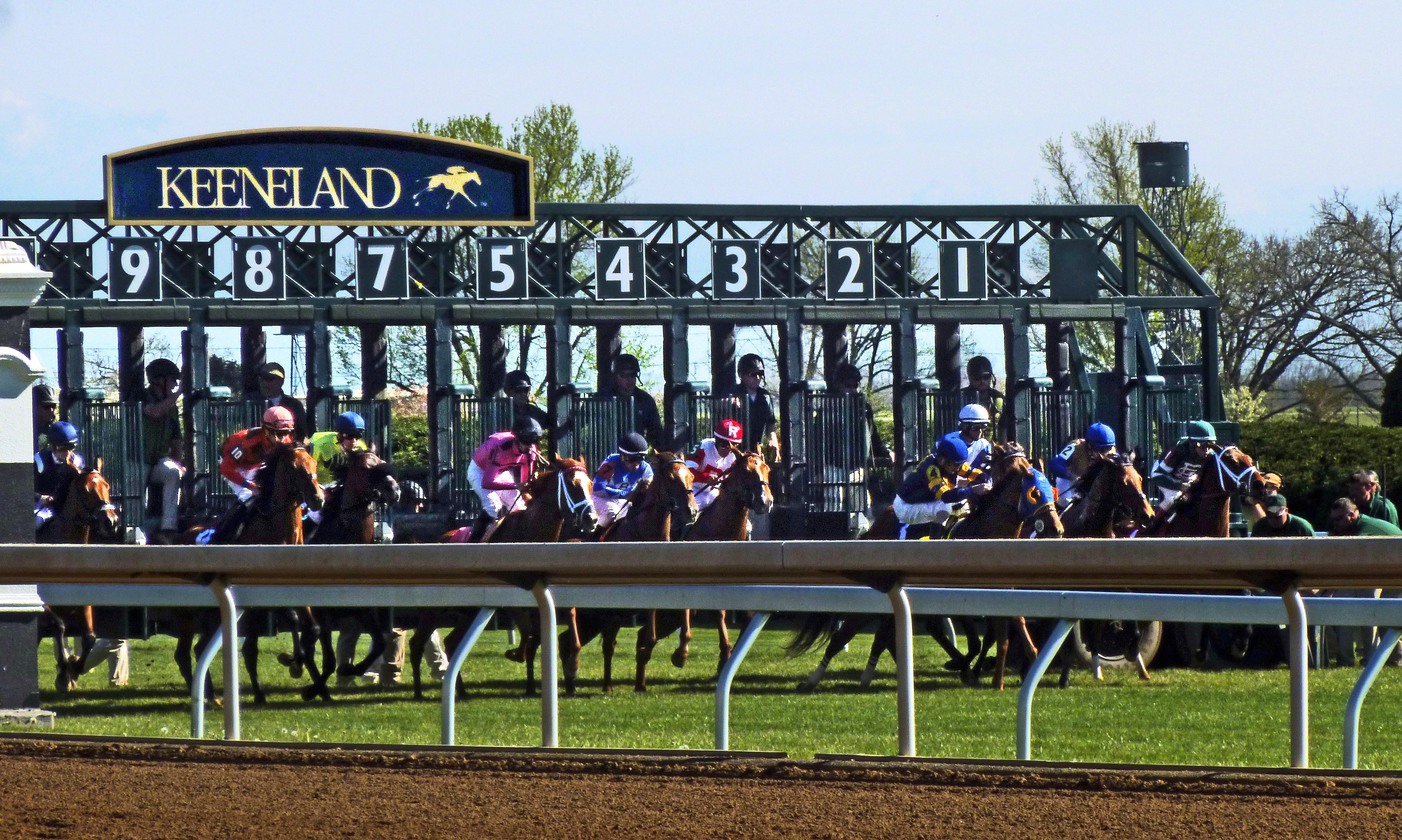
Photograph: the start of the 2016 Appalachian Stakes at Keeneland, by Calstanhope / Wikimedia Commons, CC BY-SA 4.0. Web-optimized; displayed crop. This photograph illustrates Keeneland today rather than the historical race described below.
The Road to Keeneland · Part Four
Originally published September 22, 2026.
Bourbon. 🥃 Sharp-dressed men in sport coats. Women who looked as though going to the races was still an occasion worth dressing for. Racing programs folded under arms. Glasses clinking. Horses circling the paddock. Conversations everywhere. There is a certain picture people have in their minds when they think about horse racing, especially the old racetracks. Even if you’ve never been to one, you’ve probably seen enough photographs and movies to understand the feeling. There’s the pageantry of it—the colors, the hats, the jockey silks, the beautiful horses, the betting windows, and the characters who seem to know exactly where to stand and exactly what they’re looking for.
And then there’s Kentucky. There was a time when Thoroughbred racing occupied a much bigger piece of American sporting life. Maybe your parents remember it. Maybe your grandparents do. Horses like Secretariat, Citation, Man o’ War, Seattle Slew and Affirmed became household names. So did jockeys and trainers. The Kentucky Derby wasn’t simply another sporting event on the calendar. It was part of American culture. They didn’t call horse racing the Sport of Kings for nothing.
My introduction to one of the most beautiful racetracks in America, however, was considerably less elegant. I was there to work. In 1994, I was a young guy working for United Tote, and when the Turfway Park meet ended, our job didn’t end with it. The tote system and point-of- sale wagering terminals had to move to the next racetrack. That meant loading equipment onto a truck and heading south toward Lexington. By the time we arrived at Keeneland, it was late, so my grand introduction to this legendary racetrack wasn’t walking through the gates wearing a sport coat with a bourbon in my hand. It was unloading a truck. That was my first trip to Keeneland.
But the next morning was different. Driving back in daylight, Kentucky began revealing itself. Rolling pastures. Horses. Stone walls. Beautiful farms. And somewhere along that drive, Calumet Farm. Then we approached Keeneland, and that’s when I started noticing the green. The fences were green. The facility trucks were green. Employees were wearing green. Attendants wore green sport coats. But it wasn’t just any green. It was this deep, unmistakable shade that seemed to belong to the place. Keeneland Green. I remember looking around and thinking, They have their own freaking color. And somehow, that told me almost everything I needed to know. This place was different.
There are places you visit, and there are places that immediately feel like something more. My first daylight look at Keeneland in 1994 was the beginning of a fascination that has lasted more than three decades.
Keeneland had been doing things differently almost from the beginning. The track opened in 1936 after a group of Central Kentucky horsemen set out to create what they described as a model race track—a place designed around the horse, the sport and the experience of racing. What struck me in 1994 was how much of that philosophy you could still feel. Keeneland didn’t feel like someone had simply built a grandstand next to a racetrack. It felt like an estate that happened to have horse racing. The stone, the trees, the grounds, the architecture, the horses—everything seemed intentional.
Which made what happened next even stranger.
Eventually the racing started. The horses came onto the track, the crowd moved toward the rail, people studied their programs and bets were placed. Our United Tote equipment was doing exactly what it was supposed to be doing. The horses loaded into the gate, and then they were off. I watched the race for a few seconds and something felt wrong. Not bad. Just… missing.
If you grew up around horse racing—or even if you’ve only watched the Kentucky Derby on television—you know the rhythm of a race caller. The horses break from the gate and the announcer begins guiding you through the field. One horse takes the lead, another moves up on the outside, somebody starts making a move around the turn. The announcer’s cadence gets faster, the crowd gets louder, and people start screaming the name of whichever horse they have money on. By the time they reach the stretch, the announcer is practically part of the race.
Except at Keeneland that day. There were horses, a crowd, pounding hooves and plenty of yelling, but there was no voice coming over the speakers telling us what was happening. I remember thinking,
Where’s the announcer? Or, more accurately, Where the hell is the track announcer? The horses broke from the gate, the crowd came alive—and something was missing. In 1994, Keeneland still raced without an on-track race caller, preserving a tradition that had existed since the track opened.
It turned out nothing was broken. That was Keeneland. For the first 60 years of its existence, Keeneland did not have an on-track race caller. That tradition lasted until April 4, 1997, when Kurt Becker became the first track announcer in Keeneland history. So there I was in 1994, standing inside a tradition I didn’t even know was a tradition. That’s one of the funny things about being young. Sometimes you don’t know you’re standing inside a piece of history while it’s happening. You’re just at work.
Keeneland was full of things like that. It was deeply traditional, but it wasn’t afraid of technology. In fact, that was part of the irony of me being there. I had arrived because of technology — United Tote, computers, wagering systems, point-of-sale terminals and all of the machinery required to process thousands of wagers while the horses were running outside.
Yet the technology never seemed to become the experience. The horses were still the experience. The people were still the experience. The place was still the experience. Technology simply served it. That idea has stuck with me.
Keeneland’s unique racing calendar contributed to that feeling, too. It wasn’t a place that raced endlessly throughout the year. Its spring and fall meetings made racing there feel more like an event. And spring in Kentucky meant something else was coming: the Kentucky Derby.
Keeneland’s first Spring Meeting was held in 1937, and that same meeting included the first running there of the Blue Grass. Its winner, Fencing, was racing in the Kentucky Derby just nine days later.
That relationship between Keeneland, the Blue Grass and the road toward Louisville became part of the rhythm of spring racing in Kentucky.
But statistics and history books only explain part of Keeneland. The rest of it is atmosphere. The paddock. The horses walking past you. The sound of their shoes on the pavement. The racing programs. The clothes. The conversations. The bourbon.
Especially the bourbon. 🥃 At Keeneland, racing has always been about more than what happens on the track. The horses, the people, the bourbon and the rituals surrounding the meet are all part of the experience.
Maker’s Mark and Keeneland have a history together that goes back much farther than I realized at the time. During Keeneland’s 1958 Fall Meeting, its caterer purchased the first case of Maker’s Mark under its Kentucky liquor license, allowing racing fans there to buy the bourbon. Decades later, in 1997, Keeneland and Maker’s Mark began their commemorative bottle partnership, which has since raised millions of dollars for Kentucky organizations and causes. Eventually, my own fascination with Keeneland turned me into an official Maker’s Mark Ambassador. Of course it did. Go to their website for more information on the process as well as touring the distillery. Today, I have Keeneland memorabilia in my office. I have a special Thoroughbred shelf, and there may or may not be a display closet in our house containing even more memorabilia. Angie might argue that once a collection requires dedicated closet space, we have officially moved beyond calling it “a few souvenirs.” She might have a point.
But the older I get, the more I realize something about those things. It isn’t really the stuff. It’s what the stuff unlocks. A racing program can unlock a morning. A photograph can unlock a conversation. A bottle can unlock a trip. A hat can suddenly put you back somewhere you haven’t thought about in 25 years. That is probably why certain objects become more meaningful as we get older. They aren’t valuable because of what they are. They’re valuable because of where they take us.
And when I think about Keeneland, eventually I stop thinking about the buildings and the horses and the green fences. I start thinking about the people.
Steve Walker was United Tote’s Regional Manager in Kentucky back then. Steve could see that I was fascinated by Keeneland. Maybe I asked too many questions. Maybe I spent too much time looking around. Maybe it was painfully obvious. Whatever the reason, Steve did something that probably seemed fairly ordinary to him at the time. He invited me to stay and work the meet. The places matter. The traditions matter. But when we look back, it’s often the people who made the biggest difference. Steve Walker gave a young United Tote employee the chance to stay and experience Keeneland from the inside.
That invitation changed my experience completely. Visiting Keeneland is one thing. Working Keeneland is another. You see the place before the public arrives. You see the employees preparing, the operations behind the scenes, the equipment being checked and the systems coming online. Then the gates open, and slowly the place changes. People arrive dressed for the races. Programs appear. Families gather. The paddock fills. Betting windows get busy. Glasses get poured. Horses begin moving toward the track. And suddenly the quiet place you saw that morning becomes Keeneland.
Steve gave me enough time there to fall in love with the place. I don’t know whether he ever realized how significant that invitation became for me. That is another thing I understand better now than I did then. Sometimes people open doors for us without realizing how important those doors will become. At the time, it can feel like nothing more than, Hey, why don’t you stay and work the meet? Thirty-plus years later, you realize you still remember the invitation.
That’s what this Journey to 60 has been teaching me.
When we’re young, most of us spend a lot of time looking forward—the next job, the next opportunity, the next city, the next paycheck, the next promotion, the next chapter. We rarely stop in the middle of an ordinary day and think, You might want to remember this. Why would we? We assume there will always be another day just like it.
Then enough years pass, and suddenly you begin looking backward differently. Not because you necessarily want to go back. I don’t. But I do want to understand the road. That’s different. We rarely know which ordinary days will become part of our story. More than 30 years later, Keeneland reminds me that sometimes a job takes you somewhere—and sometimes that place becomes part of who you are.
The funny thing is, none of this seemed particularly profound in 1994. I was working. We were moving equipment. A racetrack was opening. There were terminals to set up, systems to check and people who had jobs to do. I wasn’t standing there thinking about memory or aging or the Journey to 60. I was probably thinking about whether the equipment worked—and wondering why the racetrack didn’t have a freaking announcer.
But that’s the beauty of some of the best chapters of our lives. We don’t always know we’re in one while we’re living it. Sometimes it takes 30 years before we understand what the chapter was actually about. I thought Keeneland was teaching me about horse racing. I believe it taught me about something else:
Places, people, tradition, opportunity, memory, and how one seemingly ordinary invitation can change the road ahead.
First, they had their own freaking shade of green ‘Keeneland Green’ available at Home Depot lol. Next, I discovered they didn’t have a track announcer, which speaks to the traditions of a modal racecourse. Lastly, Mr. Walker had just given a young man from Iowa the opportunity of a lifetime, to stick around long enough to see what else this place was hiding.
Turns out, quite a bit.
To be continued.
— Allen S. Robinson PACIFIC44 | THE PACIFIC44 JOURNAL Stories for the Road to 60 & Beyond Live Well • Stay Curious • Keep Moving.
Continue The Road to Keeneland
Image
Gallery.


Join the Journey!
Stories, places, music, ideas & inspiration for the journey to 60 and beyond — delivered from Pacific44.

Explore
Related posts.

Follow the
Journey.
@pacific44_lifestyle