


The Road to Keeneland — Part Two: The Guys Behind the Tote Board
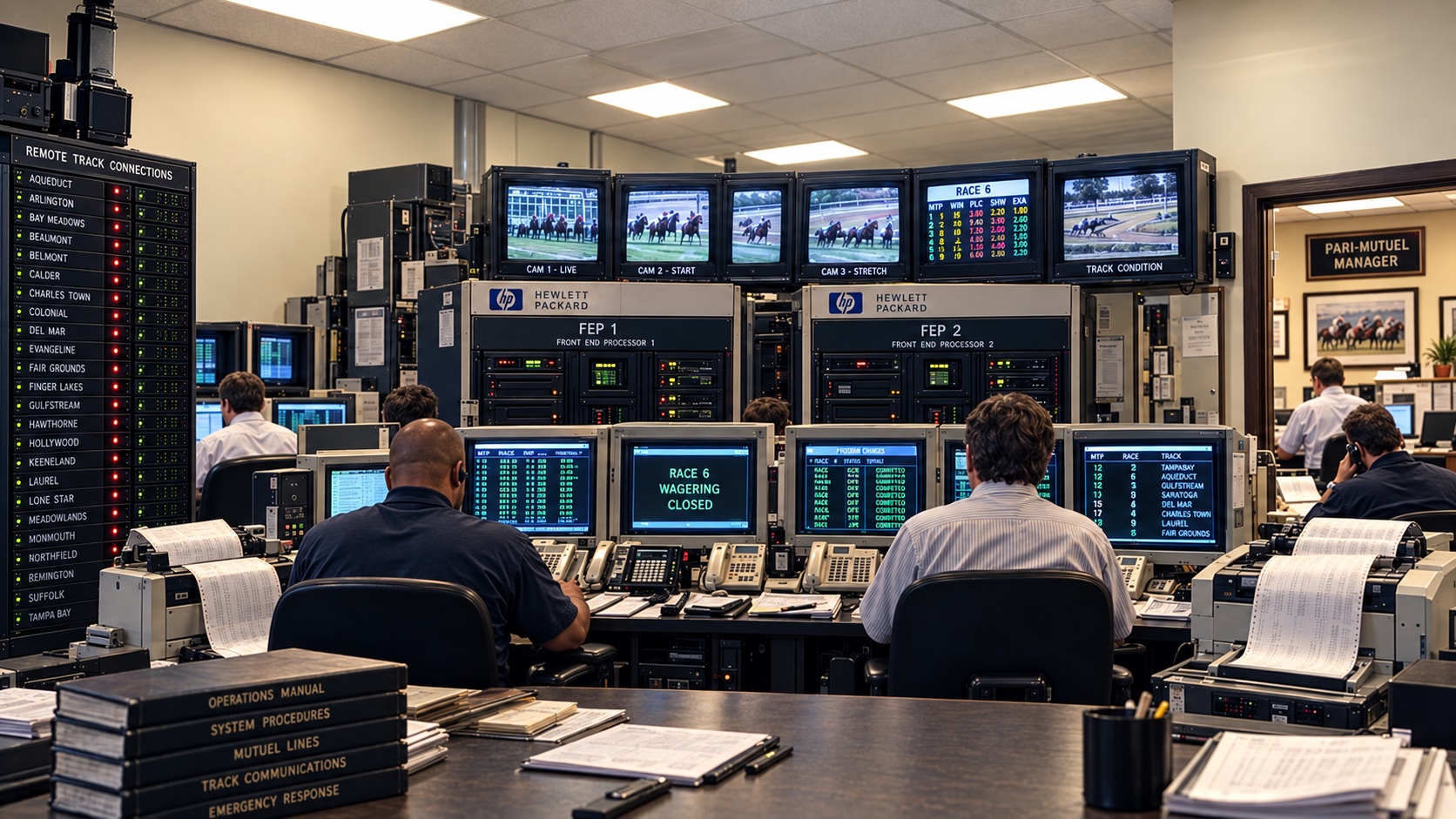
Inside United Tote’s early-1990s computer room: race-day responsibility, a wall of modems, noisy printers and the people who kept the wagering pools connected.
Originally published September 16, 2026.
Part Two: The Guys Behind the Tote Board
Most people at the racetrack never knew we were there. That usually meant we were doing our jobs.
On Monday I told you a little about how an unexpected career in racing eventually put me on a road from Turfway Park toward Keeneland. Before I get to that first trip to Lexington, though, there’s another part of the story I wanted to share because it was such a big part of my life back then, even though most people who went to the racetrack probably never knew it existed.
At the tracks where I worked, our office was usually a computer room located next to the pari-mutuel manager’s office. That was where the United Tote system lived, and where we spent our race days making sure the technology behind the wagering operation did exactly what it was supposed to do.
Most fans never saw any of this. They saw the betting windows, the odds on the tote board and the ticket in their hand. They watched the horses in the paddock, heard the call to post and found a place to watch the race. Meanwhile, there was an entirely different race day happening inside our computer room.
Our United Tote system at Turfway Park ran on Hewlett-Packard mainframe technology with two front-end processors, FEP 1 and FEP 2, operating in a duplex configuration. The idea was pretty simple even if the technology behind it wasn’t. This was a live wagering environment, and reliability mattered. There wasn’t much room for the system to decide it wanted to take the afternoon off.
There were computer workstations around the room, several telephones, closed-circuit televisions, large dot-matrix printers and equipment everywhere. Some of the televisions carried the live racing signal because we actually needed to see what was happening on the racetrack. When the horses left the starting gate, wagering had to be locked on the terminals.
So when those gates opened, we were watching too.
Not because we had a bet on the race. We had a job to do. Other monitors showed camera views of the tote board itself. That was important because sending information from the computer system was only part of the process. We also needed to confirm that the information was actually being displayed correctly outside. We could watch the indicator panels, the flip discs or bulbs and the message boards and make sure everything stayed on and the race information and prices were being displayed as expected.
It was a little like having two views of the racetrack at the same time. We could see what the computer system said was happening, and we could see what the customer standing outside was actually seeing.
Then there were the phones.
We communicated with the state racing stewards and the mutuel operation throughout the day. Race results would be called down so they could be entered into the system. Inquiry notifications came through. The official order of finish had to be approved before everything could move forward. Minutes-to-post for the next race had to be set, and then the whole process started again.
Race after race, there was a rhythm to it.
One of the things I remember most clearly is the sound of those big dot-matrix printers. We had them on both sides of the operations desk, printing reports on continuous-feed paper. Anyone who worked around computers in that era remembers that sound. It wasn’t exactly quiet. 😂 But there was another part of the room that I think says a lot about how advanced the racing industry actually was at the time.
We had a wall of modems.
This was the early 1990s, long before anybody walked around talking about being connected all the time. There was no Wi-Fi, no smartphones and none of the technology we take for granted today. Yet racetracks around the country were connecting to our tote system and participating in the wagering pools on Turfway Park races.
There could be 50 or more tracks taking the Turfway racing signal. Their customers could watch our race from another racetrack hundreds or even thousands of miles away, place a wager there, and those wagers would ultimately become part of the commingled pools being processed through our system.
Think about that for a moment.
A customer might be standing at another racetrack somewhere across the country watching the Turfway Park signal. They could make a wager on one of our races, and that wagering information and money had to make its way into the pools we were managing back in Kentucky.
That wall of modems represented all of those connections.
When the horses left the gate and wagering closed, it wasn’t simply the windows downstairs at Turfway that mattered. We were dealing with a network of racetracks participating in the same wagering pools.
I don’t think I appreciated how sophisticated all of that was at the time.
To us, it was just race day.
You came into the computer room, checked the systems, made sure the terminals were communicating, watched the monitors, answered the phones, listened to the printers, kept an eye on all those connections and got ready for the next race.
When everything worked correctly, nobody in the grandstand needed to know our names.
If something didn’t work correctly? People figured out where the computer room was pretty quickly. 😂 There was a group of us doing this work back then, mostly young guys, and that’s probably another reason I remember those years so fondly. We traveled around the country working at racetracks and operating these systems. It was a pretty unusual way to make a living when you were in your twenties.
We were working with serious technology and carrying a lot of responsibility, but we were still young guys having a pretty good time along the way.
And apparently we all thought we needed nice sports cars.
I still laugh about that. I don’t know whether it was a United Tote thing, a young-guy thing or simply the era, but quite a few of us seemed to have something pretty nice sitting in the employee parking lot. Practical transportation apparently wasn’t very high on our list of priorities. 😂 What I didn’t recognize at the time was that the job was giving me something besides a career in technology.
It was giving me access.
When you spend enough time working at racetracks, eventually you start looking beyond the computer screens. You hear trainers talking. You recognize jockeys. You begin paying attention to what happens in the paddock. Farm names that once meant nothing start becoming familiar. You learn why certain races matter and why people in the industry speak about certain racetracks with a different kind of respect.
I didn’t enter the business knowing much about Thoroughbred pedigrees or Kentucky horse farms. Computers were my comfort zone.
But eventually I started spending more time looking outside the computer room. That’s really how my appreciation for Thoroughbred racing developed. I wasn’t studying the sport because somebody told me I should. I was fortunate enough to be around it, and over time I became interested in the horses, the people, the farms, the history and all of the traditions surrounding it.
The technology got me through the door.
What was on the other side of that door was becoming much more interesting.
Turfway Park became an important part of that experience. I eventually had the opportunity to run tote operations there in Florence, Kentucky, and for the duration of a racing meet that computer room next to the pari-mutuel manager’s office became a pretty big part of my world.
Then the meet ended.
After the final race, the grandstand started emptying. The betting windows closed. People headed to the parking lot and went home. For most of them, the racing meet was over.
For us, there was still work to do.
Back then, some of that wagering equipment didn’t simply stay in one place waiting for another racing season. The terminals and tote equipment being used at one property could be needed at another racetrack whose meet was about to begin.
At the conclusion of Turfway’s late-summer/early-fall meeting in 1994, we already knew where our equipment was going next.
Keeneland.
It was roughly 80 miles down the road in Lexington. I knew the name, of course, and by then I knew enough about racing to understand that Keeneland was special. But I had never been there.
At that moment, I wasn’t thinking about history or beautiful Kentucky horse farms or one of the great racetracks in America.
We had equipment to move.
I had no idea that the drive to our next job would become one of the things I remembered most from that entire period of my life.
More than 30 years later, I can still picture it.
That’s where I’ll pick up the story tomorrow.
The Road to Keeneland continues in The Pacific44 Journal.
Live Well • Stay Curious • Keep Moving.
PACIFIC44 | THE PACIFIC44 JOURNAL Stories for the Road to 60 & Beyond.
Continue The Road to Keeneland
View all chapters in reading order →
Image
Gallery.


Join the Journey!
Stories, places, music, ideas & inspiration for the journey to 60 and beyond — delivered from Pacific44.

Explore
Related posts.

Follow the
Journey.
@pacific44_lifestyle