

What Are You Saving for the Kids?
Not the money. The stories. Allen reflects on family memories, his Woodford Reserve Derby collection, and giving our children the stories behind the things we save.
Not the money. The stories.
Originally published September 24, 2026.
I know a lot about my parents. At least I thought I did. I know where they worked. I know where we lived. I know the family stories that have been repeated so many times over the years that everybody can practically finish them. But the older I get, the more I realize there are all kinds of things I never thought to ask, and most of them are the little things.
What did you do on a Friday night when you were 23? Where did you go when you had a few extra dollars in your pocket? What song made you reach over and turn up the radio? Who was the funniest person in your group of friends? What did you spend your first real paycheck on? What did you think your life was going to look like before life actually happened?
The question I really wish I’d asked more often is even simpler:
Who were you before you were my parent?
My dad passed away in 2017, and there are things I’d love to sit down and ask him now. Nothing profound. I’d just like another conversation. I’d pour something, sit down and ask about the things I was either too young or too busy to think about when I had the chance.
That’s one of the strange things about getting older yourself. For most of your life, your parents are simply your parents. You don’t spend much time thinking about the fact that there was an entire version of them that existed before you arrived. They had Friday nights. They had people they couldn’t wait to see. They had bad dates, great nights and inside jokes. They had favorite songs. They probably made some spectacularly dumb decisions. They had dreams that worked out and others that quietly disappeared. There was a whole person there before there was Mom or Dad.
Now I find myself thinking about my own kids. They know me as Dad. They know pieces of my career. They know where we’ve lived and some of the things I’ve done. They’ve heard plenty of stories, and I’m certain there are a few they’ve heard considerably more times than they ever wanted to. But do they really know the kid from Waterloo? Do they know what Waterloo felt like to me growing up? What it was like going to Edison Elementary and Central? The friends I couldn’t imagine not having around? The places everybody went? The music we listened to? The things we thought were incredibly important when we were 17?
Do they know who I was before I became their dad? Probably not as much as I think they do. And that’s understandable. I don’t remember sitting around at 25 interviewing my parents about their childhood either. I was busy being 25. You assume the people and places around you are always going to be there, so there doesn’t seem to be any urgency to ask. Then one day there is.
I’ve also started thinking differently about all the things families save. Most of us have boxes somewhere filled with old photographs, yearbooks, newspaper clippings, records, watches, jewelry, letters and things that belonged to our parents or grandparents. Nobody wants to throw them away, even when we’re not completely sure why we’re keeping them.
An old watch sitting in a drawer is just an old watch. But tell me my grandfather bought it with his first good paycheck and wore it every day for the next 30 years, and suddenly I’m looking at something entirely different.
The same thing happens with photographs. We may be the most photographed generation in history. I couldn’t begin to guess how many pictures are sitting on my phone: family dinners, trips, holidays, restaurants, people we love, dogs, sunsets and a ridiculous number of random things I apparently considered extremely important for about eleven seconds.
Fifty years from now, somebody could find one of those photographs and have absolutely no idea why I took it. They’ll see who was standing there, but they won’t know what happened five minutes before the picture. They won’t know who told the joke that had everybody laughing. They won’t know why that particular restaurant mattered or why everyone was so glad somebody decided to come that night.
The picture survives. The story doesn’t automatically survive with it.
Which brings me to something I’ve been quietly doing for years that probably sounds a little strange until I explain it: I have old military trunks filled with bourbon.
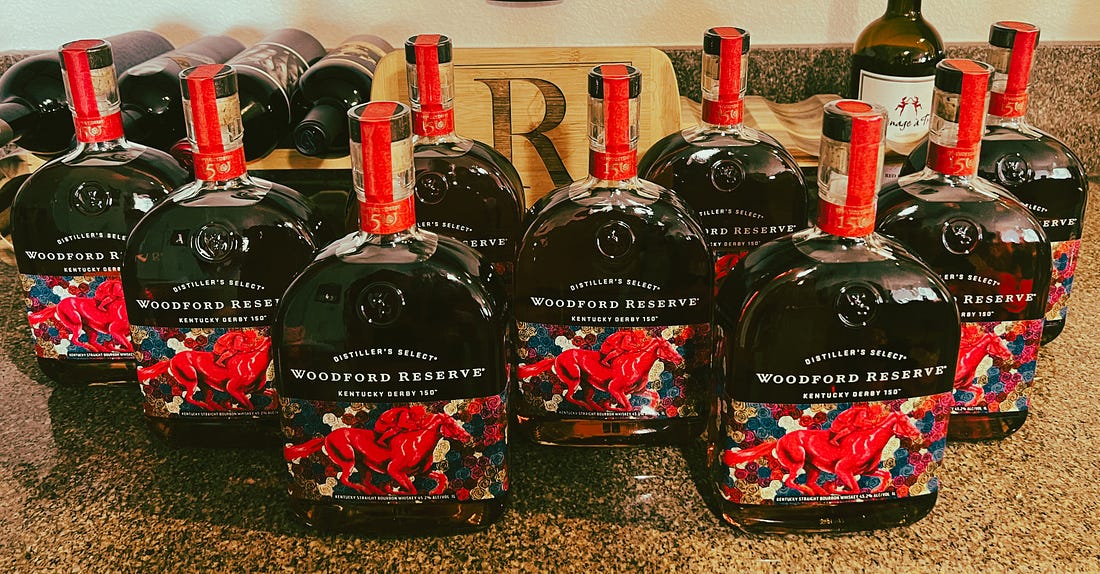
Starting with Kentucky Derby 142, I began buying the annual Woodford Reserve Kentucky Derby commemorative bottles. Every year I buy somewhere between five and ten of that year’s edition. I leave them unopened, pack them away in those trunks and wait for the next Derby.
I originally started doing it because I thought it would be something unique to leave our kids. Most of the bottles cost me around $40 when I bought them, and my thinking was pretty straightforward: what happens if I keep doing this for decades? Instead of one random collectible bottle, our kids could eventually inherit multiple runs of Kentucky Derby editions.
I’ve always wondered what that collection might look like 25 years from now. Some older Woodford Derby editions have sold for considerably more than their original retail prices, although collectibles are unpredictable and there’s obviously no guarantee what any particular bottle will eventually be worth. That uncertainty is part of the fun for me. If I keep buying five to ten bottles every year, those trunks could eventually contain hundreds of them. I’m hoping there comes a day when one of our kids opens a trunk, looks at the collection and says, “Dad actually knew what he was doing.” I’d like that entered into the permanent family record.
But while writing this story, I realized the collection could become something better than I originally intended.
Right now, I think of the bottles by Derby number: Derby 142, Derby 143, Derby 144. Twenty-five years from now, those numbers will represent years of our family’s life. There will be a bottle from the year somebody graduated. One from a year we took an unforgettable trip. One from the year a grandchild arrived. One from a difficult year we got through together. Another from a year when something happened that none of us could have predicted.
Right now they’re bottles of Woodford Reserve. Someday they’ll be markers in time.

Writing this has also given me an idea I wish I’d had when I started the collection. I’m going to start putting the story with the bottles. Nothing elaborate: a card with the Derby number and year, a photograph and a few paragraphs about what was happening in our family. Where Angie and I were living. What the kids were doing. Where we traveled. Something funny that happened. Something important. Maybe something completely ordinary that I think we’d want to remember. I can go back and do the same thing for the earlier years.
That changes those old military trunks completely. They become time capsules.
I can picture one of our kids opening a trunk 25 years from now, pulling out an old Derby bottle and finding a note from us from that year. Somebody reads it, somebody else remembers something, and before long a bottle of bourbon has started a family conversation. That might ultimately be worth more than whatever somebody is willing to pay for the bottle. Although, to be clear, I’m still hoping the bourbon is worth a fortune. Both things can be true.
There’s another reason those particular bottles mean something to me. Anyone who has been following my recent Road to Keeneland stories knows that Kentucky and horse racing became part of my life long before I started this collection. My years working around racing through United Tote took me places I never expected to go, including Keeneland, and those experiences stayed with me. So in a way, the bottles already have a story before they ever go into the trunk.
That’s what I’ve come to appreciate about the things we save. The object itself isn’t always the important part. It’s what the object unlocks.
It doesn’t have to be bourbon. Your version might be Christmas ornaments you’ve collected every year, concert tickets, vinyl records, postcards from places you’ve traveled, recipes written in your own handwriting, photographs taken in the same vacation spot over 30 years, a watch that gets passed down or a bottle of wine from every anniversary. Something completely ordinary can become something else when the story travels with it.
That’s the part I think we miss when we talk about what we’re leaving our kids. Of course we want to leave them financially secure if we’re fortunate enough to do that. We think about houses, investments, savings and possessions, and those things matter. But our kids can replace a couch. They can’t recreate a story nobody told them.
And the stories worth saving don’t have to be dramatic. Tell them about your first apartment when it comes up in conversation. Tell them about your first car and what was playing on the radio. Tell them about the teacher who saw something in you before you saw it yourself. Tell them about the terrible boss, where everybody hung out after school, the restaurant that’s gone now and the friend who could make an entire room laugh. Tell them the stupid stuff too. Especially the stupid stuff. Those are usually the stories everybody wants to hear again anyway.
The same goes in the other direction. If you’re fortunate enough to still have parents, grandparents, aunts, uncles or older family members around, ask them things you’ve never asked before. Don’t make it an interview. Just talk. Ask your mom what she did on Saturday nights when she was 20. Ask your dad about his first job. Ask your uncle who the troublemaker was in the family. Ask what the neighborhood looked like, what car everybody wanted, where they went after school or what song takes them immediately back somewhere. Then let the conversation wander. That’s usually where the good stuff is.
This is part of the Road to 60 and Beyond that was most important when we started Pacific44. I thought a lot about what was ahead, and I still do. There are places I want to see, things I want to build, experiences I want to have and plenty of road left to travel. Knowing and embracing that getting older also changes the way you look at the road behind you is the exciting part for me.
We can go back to Waterloo today, but it isn’t the Waterloo I grew up in. Edison Elementary is gone. Central High School is gone. Crossroads Mall as we knew it is gone. Places that seemed permanent when we were kids have disappeared or changed completely. Embracing the idea that people places and things do change is ok. Eventually, we all should acknowledge that we become the people who remember what those places felt like.
I find myself writing so much lately about places and people from years ago. I’ll start writing about Keeneland or an old radio station or somewhere we used to go, and before long I’m remembering people I haven’t thought about in years. One story unlocks another, and that’s what I want to save.
Someday our kids and grandchildren will end up with some of the things we’ve accumulated over a lifetime. They’ll decide what to keep, what to give away and what absolutely nobody wants despite us being completely convinced it was valuable. That’s how it goes. I’m much more interested in making sure they understand why some of those things were there in the first place.
I want them to know who the people in the photographs were and why certain places mattered. I want them to know what made us laugh, what we cared about, where we came from and what life actually felt like while we were living it. Not a polished version of it. The real one.
So the next time the family is sitting around together, ask a question that doesn’t come up nearly enough: Who were you before I knew you? Then see where the conversation goes.
You might hear something you’ve never heard before.
Years from now, when somebody pulls an old photograph out of a box —or opens one of those military trunks and finds a Woodford Reserve Kentucky Derby bottle from decades ago—I don’t want them to have to wonder why somebody saved it. I want them to know. Better yet, I want them to know the story.
And if one of those $40 bottles happens to be worth a small fortune by then, I’m certainly not going to complain.
That’s what I’m saving for the kids.
To Nico and Noah with Love!
Allen S. Robinson
PACIFIC44 | THE PACIFIC44 JOURNAL
Stories for the Road to 60 & Beyond
Live Well • Stay Curious • Keep Moving
Image
Gallery.


Join the Journey!
Stories, places, music, ideas & inspiration for the journey to 60 and beyond — delivered from Pacific44.

Explore
Related posts.

Follow the
Journey.
@pacific44_lifestyle