

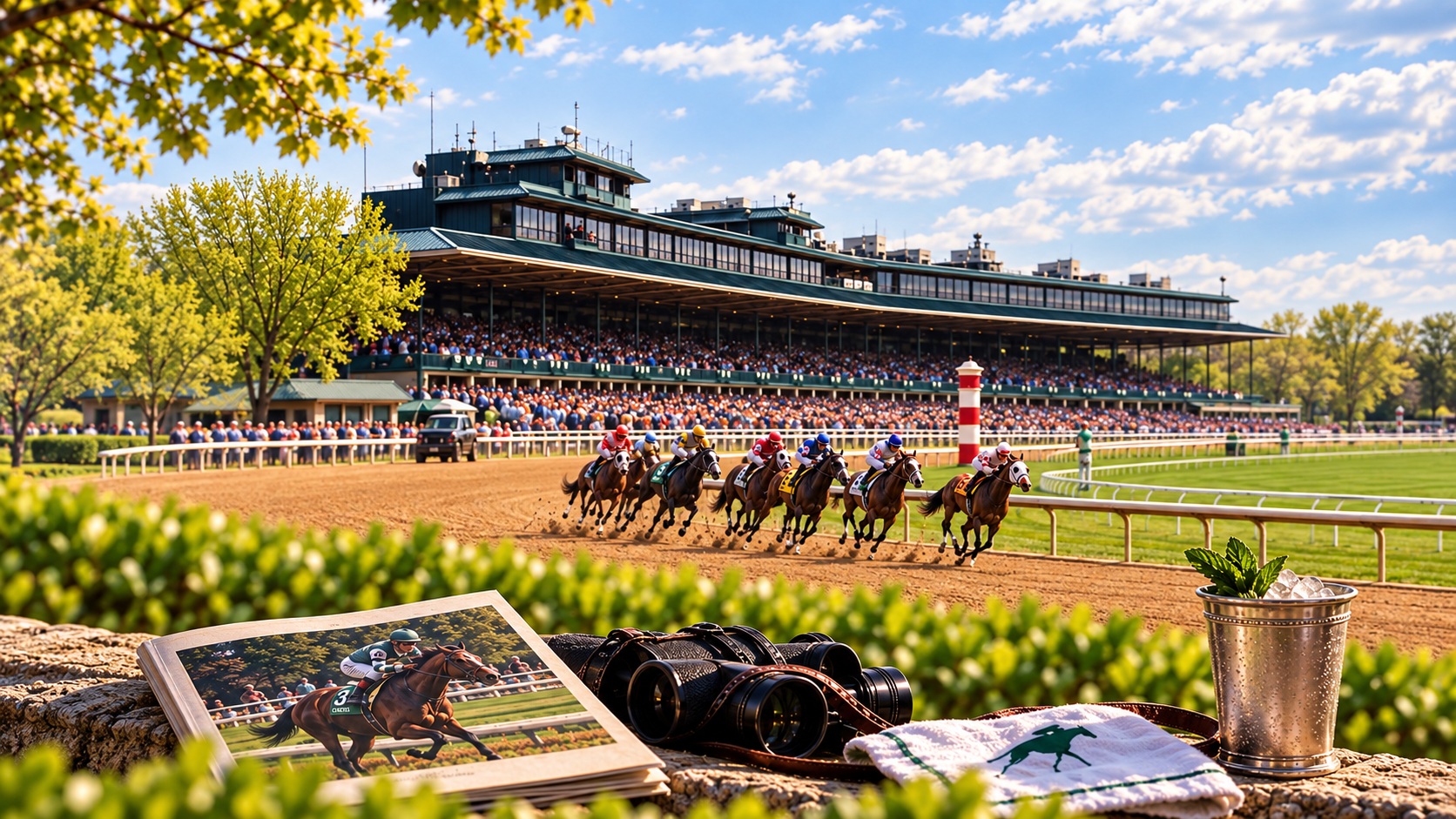

The Road to Keeneland — Part One: A Horse Named Cigar
A horse named Cigar brings Allen back to United Tote, Kentucky horse country and the unexpected road that led a young man from Waterloo to Keeneland.
Originally published September 14, 2026.
Part One: A Horse Named Cigar
One story yesterday brought back a part of my life I hadn’t thought about in a while.
Yesterday I published our Sunday Reader about The American Cigar Lounge, and while I was writing it I kept thinking about another Cigar. Not something sitting in a humidor, but one of my favorite Thoroughbred racehorses of all time.
If you followed racing during the 1990s, you probably remember Cigar. I certainly do. He was one of those horses you didn’t have to own or have money riding on to care about. You just wanted to see what he was going to do next.
Cigar won 16 races in a row. He was Horse of the Year twice and traveled halfway around the world to win the inaugural Dubai World Cup. I was working in the racing industry during those years, which probably explains why those memories are still so vivid for me.
That’s one of the things I’m beginning to enjoy about writing for Pacific44. I can start with one subject and suddenly find myself somewhere I wasn’t planning to go. Yesterday it was cigar lounges. Then I started thinking about Cigar. That took me to Kentucky, Turfway Park, Churchill Downs, Keeneland and a part of my career that was a pretty incredible experience for a young guy from Waterloo, Iowa.
I never planned on a career in racing. I stumbled into it.
I had worked at Waterloo Greyhound Park back home in Iowa. When the track closed, I was fortunate enough to have an opportunity that kept me in the industry and eventually took me to Prairie Meadows in Altoona. That was really my introduction to Thoroughbred racing.
What changed things for me, though, was getting into the technology side of the business and eventually working for United Tote Wagering Systems based out of Shepherd Montana.
Most people who go to a thoroughbred racecourse probably never think about the tote system. We called it the tote, short for totalisator, and essentially it was the technology behind pari-mutuel wagering.
You made a wager and the system captured it. Wagers from around the track flowed into the pools. The pools changed, the odds changed and, once the race became official, the system determined what winning tickets were worth.
When everything worked correctly, the thousands of people watching the races had absolutely no reason to think about any of us behind it.
That was the point.
The technology itself had been evolving for decades before I arrived. Totalisator systems started as enormous mechanical and electromechanical machines and eventually became computerized networks connecting wagering terminals throughout racetracks. By the time I came along, those systems were basically the technological heartbeat behind the wagering operation.
But when I think back on those years, the computers really aren’t what I remember most. I remember the people.
There was a group of us back then, mostly young guys, traveling around the country working at racetracks and operating these systems. We’d arrive at some of the most prestigious racing properties in America and disappear into computer rooms and tote rooms that most people sitting in the grandstand never knew existed.
We were young, we were working with some pretty serious technology for the time, and we had a lot of responsibility.
And for whatever reason, a lot of us had really nice sports cars. 😂 Looking back, I don’t know if that was a United Tote thing, a young-guy thing or just the era, but apparently driving something practical wasn’t very high on our list of priorities.
What I didn’t appreciate enough at the time was the access the job was giving me.
When you work behind the scenes at racetracks long enough, eventually you start paying attention to what’s happening outside the computer room. You notice the paddock. You learn the trainers and jockeys. You start recognizing horses and farms. You hear people talking about pedigrees. You begin understanding why certain races mean so much.
Before long, these places stopped being simply locations where we installed equipment and operated computers.
I started appreciating what surrounded them.
I entered racing because of technology. The technology gave me access to the tradition.
Kentucky was where those two worlds really came together for me. I eventually had the opportunity to run tote operations at Turfway Park in Florence, Kentucky, and suddenly I was working in a place where Thoroughbred racing wasn’t something that existed only inside the gates of a racetrack.
It was part of the culture around you.
The farms were there. The horses were there. Trainers, owners, breeders and people who had spent their entire lives around the sport were everywhere. I was beginning to see Thoroughbred racing from the inside, and I was learning without really realizing how much I was learning.
One of my favorite memories from those years started as nothing more than another work assignment.
Turfway’s late-summer/early-fall meeting was ending and Keeneland’s Fall Meet was coming next.
The wagering terminals and main tote system we had been using at Turfway needed to make the move to Lexington. That was part of the job. One meet ended, another was beginning, and the equipment had to be there.
So when our work at Turfway was finished, we loaded everything up and headed down the road.
I had never been to Keeneland.
This wasn’t a bucket-list trip. I wasn’t driving there because someone had told me I needed to see one of America’s great racetracks.
We had equipment to deliver.
But as we got closer to Lexington, something changed.
I started seeing Kentucky Thoroughbred country for the first time.
The landscape seemed to open up. There were rolling fields, horses grazing behind immaculate fencing, old barns and those beautiful stone walls that seem to belong to Kentucky.
Then there were the farm names.
Names I was beginning to recognize from racing. I remember passing Calumet Farm along Versailles Road, one of the great names in American Thoroughbred history, and realizing I was now seeing places I had previously only heard people talk about around racetracks.
For somebody still relatively new to that world, it was something to see.
You could feel the history before you ever reached the racetrack.
We kept driving toward Keeneland.
And then the fences changed. They turned Keeneland green.
I can still picture that more than 30 years later.
At the time, I didn’t know much about Keeneland’s founders or their idea of creating a model racecourse. I didn’t know that the place had opened in 1936 or how intentionally the property had been designed around the horse and the traditions of racing.
I didn’t know any of that yet.
All I knew was that as we continued down that road, the buildings in the distance started getting larger.
And my first thought was pretty simple. It looked like a castle.
That was my introduction to Keeneland.
Not from a grandstand seat.
Not on vacation.
Not as something checked off a list.
I arrived as a young tote operator with equipment that needed to be ready for another race meet.
I had no idea then how much that place—or that period of my life— would stay with me.
But it did.
More than three decades later, I can still see those green fences. And tomorrow, I’ll take you the rest of the way through the gates.
The Road to Keeneland continues Tuesday in The Pacific44 Journal.
Live Well • Stay Curious • Keep Moving.
PACIFIC44 The Pacific44 Journal Stories for the Road to 60 & Beyond.
Continue The Road to Keeneland
Image
Gallery.


Join the Journey!
Stories, places, music, ideas & inspiration for the journey to 60 and beyond — delivered from Pacific44.

Explore
Related posts.

Follow the
Journey.
@pacific44_lifestyle